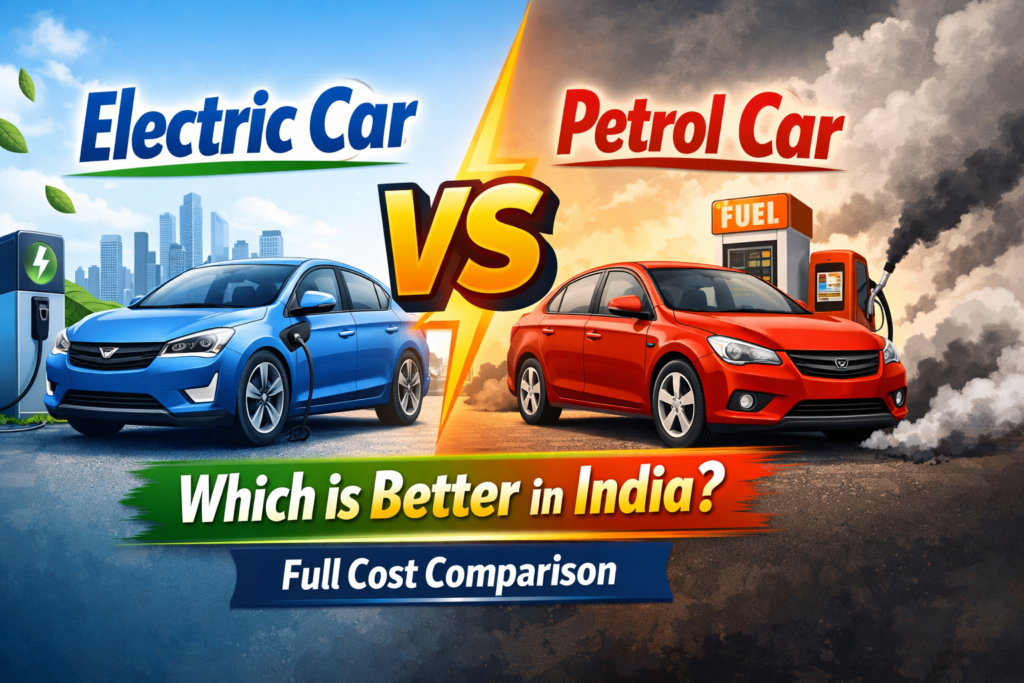
Choosing between an electric car (EV) and a petrol car is one of the biggest decisions for Indian buyers today. With rising fuel prices, government incentives, and growing EV technology, many people are confused about which option is better.
In this detailed guide, we will compare electric cars vs petrol cars in India based on cost, performance, maintenance, and long-term savings in very simple words.
1. Basic Difference Between Electric and Petrol Cars
Electric Car (EV):
- Runs on electricity (battery-powered)
- Needs charging instead of fuel
- Environment-friendly
Petrol Car:
- Runs on petrol fuel
- Requires regular refueling
- More traditional and widely used
2. Initial Purchase Cost (Upfront Price)
One of the biggest differences is the buying price.
- Petrol cars are cheaper initially
- Electric cars are more expensive upfront
👉 In India:
- Petrol cars (budget segment): ₹5–10 lakh
- EV cars (budget segment): ₹8–15 lakh
However, EV prices are slowly decreasing due to government schemes like subsidies and tax benefits.
✔️ Conclusion:
If you have a low budget, petrol cars are easier to buy.
3. Running Cost (Fuel vs Charging Cost)
This is where EVs become very powerful.
Petrol Car Running Cost:
- Petrol price: ₹100–₹110/litre
- Mileage: 15 km/l
👉 Cost per km: ₹6–₹7/km
Electric Car Running Cost:
- Electricity: ₹6–₹10/unit
- Efficiency: 6–8 km/unit
👉 Cost per km: ₹1–₹2/km
Example (Monthly 1000 km use):
- Petrol car: ₹7,000/month
- Electric car: ₹1,500–₹2,000/month
👉 Annual savings: ₹60,000+
✔️ Conclusion:
Electric cars are 4–5 times cheaper to run than petrol cars.
4. Maintenance Cost Comparison
Maintenance is another major factor.
Petrol Car:
- Engine oil change required
- More moving parts
- Regular servicing
👉 Annual cost: ₹10,000–₹15,000
Electric Car:
- No engine oil
- Fewer moving parts
- Less wear and tear
👉 Annual cost: ₹4,000–₹6,000
✔️ Conclusion:
EVs have lower maintenance cost and fewer problems.
5. Insurance Cost
- EV insurance is slightly higher
- Reason: expensive battery
👉 Difference: around ₹3,000–₹5,000 extra per year
✔️ Conclusion:
Petrol cars are cheaper in insurance, but the difference is small.
6. Battery Cost & Life (EV)
One concern with EVs is the battery.
- Battery life: 6–8 years (approx)
- Replacement cost: ₹1.5–₹5 lakh (depends on car)
But:
- Most companies give 8-year warranty
- Battery cost is decreasing every year
✔️ Conclusion:
Battery replacement is costly but not frequent.
7. Convenience: Refueling vs Charging
Petrol Car:
- Refuel in 5 minutes
- Petrol pumps available everywhere
Electric Car:
- Charging time: 4–8 hours (home charging)
- Fast charging available but limited
Charging infrastructure is improving but still growing in India.
✔️ Conclusion:
Petrol cars are more convenient for long trips.
8. Environment Impact
Petrol Car:
- Produces pollution
- Harmful emissions
Electric Car:
- Zero tailpipe emissions
- Eco-friendly
✔️ Conclusion:
EVs are better for environment and health.
9. Performance & Driving Experience
Petrol Cars:
- Good for highways
- Better range
Electric Cars:
- Instant acceleration
- Smooth & silent driving
✔️ Conclusion:
EVs feel more modern and smooth in city driving.
10. 5-Year Cost Comparison (Important)
Let’s compare total cost for 5 years:
Petrol Car (Example):
- Fuel cost: ₹80,000/year
- 5 years: ₹4,00,000
- Maintenance: ₹60,000
👉 Total: ₹4.6 lakh (approx)
Electric Car:
- Charging cost: ₹20,000/year
- 5 years: ₹1,00,000
- Maintenance: ₹25,000
👉 Total: ₹1.25 lakh (approx)
✔️ Savings: ₹3–3.5 lakh in 5 years
11. Advantages & Disadvantages
✅ Electric Car Pros:
- Very low running cost
- Low maintenance
- Eco-friendly
- Smooth driving
❌ Electric Car Cons:
- High initial cost
- Charging time
- Limited charging stations
Petrol Car Pros:
- Lower purchase price
- Easy refueling
- Better for long trips
❌ Petrol Car Cons:
- High fuel cost
- More maintenance
- Pollution
12. Which is Better in India?
👉 Choose Electric Car if:
- You drive daily (city use)
- Monthly running is high (1000+ km)
- You want long-term savings
👉 Choose Petrol Car if:
- Your usage is low
- You travel long distances frequently
- You want lower upfront cost
Final Verdict
In India, electric cars are better in the long run, especially for city users. They save a lot of money on fuel and maintenance.
However, petrol cars are still a good choice for:
- Budget buyers
- Long-distance travelers
- People without charging access
👉 Simple Answer:
- Short-term → Petrol car is better
- Long-term → Electric car is better
✍️ Conclusion
Electric vehicles are the future of India. With rising petrol prices and government support, EVs are becoming more practical every year. While petrol cars still dominate today, electric cars offer better savings, lower pollution, and modern driving experience.
If you are planning to keep your car for many years, an electric car can save you lakhs of rupees.